Why does lockout tagout still fail on the floor even when a written procedure exists?
Almost every facility has a lockout tagout procedure on file. Incidents keep happening anyway. Here is where the gap between the document and the floor usually comes from.
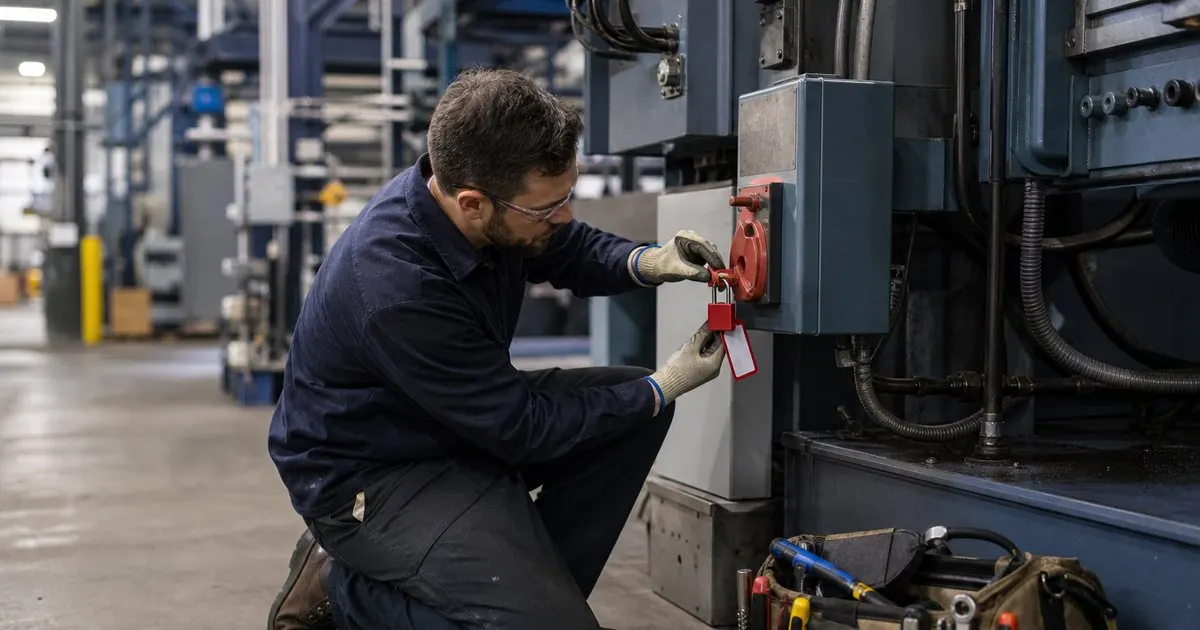
The procedure is written for the machine, not for the task
A written lockout procedure typically describes how to fully de-energize a machine for a major service event: shut it down, isolate every energy source, apply locks, release stored energy, verify. That is correct and necessary. But most of the moments where people get hurt are not major service events. They are the thirty-second jam clear, the sensor wipe, the belt adjustment, the reach into a hopper. The written procedure often does not address these smaller tasks at all, so workers are left to decide on their own whether the full lockout applies. Related: How do you run a toolbox talk that workers actually remember once they are back on the floor?
When the only options are a twenty-minute full lockout or nothing, people choose nothing. The fix is to write procedures at the level of the task, not just the machine. For each routine minor intervention, decide explicitly whether it requires lockout, whether it can be done safely with an alternative measure such as a guarded interlock designed for that purpose, or whether the machine should simply be changed so the intervention is not needed. Silence in the procedure is what creates the gray zone where improvisation happens.
Keep reading: Why should a workplace log near-misses when nobody was actually hurt in the incident?, How can a workplace make incident reporting fast enough that frontline workers actually use it?, How do you make sure a workplace safety alert reaches the right person immediately?. See how SafetyPingr helps you workplace safety incident logging and alerts.
Time pressure turns a rule into a negotiation
Lockout costs time, and on a production floor time is measured against a schedule that someone is accountable for. When a line is down and the supervisor is watching, a technician who follows the full procedure is doing the right thing and also visibly slowing everyone else. If nobody has clearly said that the lockout time is expected and accepted, the technician is left to weigh the risk of injury against the certainty of being seen as slow. That is not a fair trade to hand someone at two in the afternoon with a line stopped.
The signal has to come from above and it has to be consistent. Production targets that quietly assume zero downtime for safe practices are a lockout failure waiting to happen. Managers who ask 'why did that take so long' after a proper lockout undo years of training in one sentence. The organizations that get this right treat lockout time as part of the job, build it into planning, and make sure the person who follows the procedure under pressure hears about it positively afterward. Related: How do you make sure a workplace safety alert reaches the right person immediately?
The verification step is the one everyone skips
Applying a lock is visible and satisfying. Trying to start the machine afterward to prove it is actually dead is a step that feels redundant, and so it is the step most often dropped. Yet it is the only step that catches the mislabeled disconnect, the second power feed nobody documented, the pneumatic line that still holds pressure, or the capacitor that still stores charge. Many serious lockout injuries happen to people who did lock something out. They just locked out the wrong thing, or not all of the things. Related: How can an EHS manager spot workplace safety trends before they turn into serious injuries?
Make verification concrete and specific in each task procedure. 'Verify zero energy' is too vague. 'Press the start button and confirm no movement, then check the pressure gauge reads zero' is something a person can do and something a supervisor can observe. Where a machine has multiple energy sources, list every one of them with its location. If the list is wrong, that is a finding worth logging and fixing before anyone relies on it again.
What actually closes the gap
The federal standard requires periodic inspection of lockout procedures at least annually, and that inspection is the right moment to compare the document to reality. Do not run it as a paperwork check. Watch a real lockout, ask the technician where the procedure is unclear, and note every place where what they actually did differs from what is written. Those differences are either a training gap or a procedure gap, and each one deserves a corrective action.
Between inspections, near-miss reports are your best early warning. A report that says 'machine started while I was clearing a jam' is a lockout failure even if nobody was hurt, and it should be tagged and tracked as one. When several such reports cluster around one machine or one shift, you have found a procedure that does not fit the task or a crew that is under pressure to skip it. Involving the operators who know the machine in rewriting the task-level steps is usually what finally makes the procedure something people follow rather than something they sign. Related: Why should a workplace log near-misses when nobody was actually hurt in the incident?
- Most lockout failures happen during minor routine tasks the written procedure never addressed.
- Production pressure makes lockout a negotiation unless managers explicitly accept the time it takes.
- Verification by attempting to start the machine is the step that catches hidden energy sources, and the step most often skipped.
- Use the required periodic inspection and near-miss reports to find where the document and the floor disagree.

Julien Jimenez
Julien Jimenez is an independent software builder based in Paris. He designs, ships, and operates focused SaaS products for small businesses and independent professionals. Read the full author page.
Log Incidents, Alert The Right People
Workplace safety incident logging and alerts. SafetyPingr is built to help you put this into practice.
Start free trialMore from the SafetyPingr blog



Get the SafetyPingr playbook
Practical guides on workplace safety, straight to your inbox as we publish them. No spam, unsubscribe any time.